
Developing Intercultural Competence through Narrative Métissage
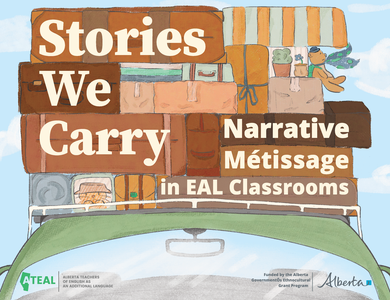
ATEAL’s “Developing Intercultural Competence through Narrative Métissage” project is a Train-the-Trainer program, designed to equip English as an Additional Language (EAL) instructors with pedagogical skills and confidence through hands-on use of Narrative Métissage — an approach rooted in Indigenous ways of learning that weaves diverse personal stories to foster connection, understanding, and learning.
The project offers a comprehensive facilitator guide and mini-documentary documenting the process to support instructors in exploring and applying this approach in their own contexts. Through engaging with Narrative Métissage, instructors can strengthen their intercultural competence, deepen anti-racism and decolonization practices, and create more inclusive, relational, and reflective learning environments for newcomers and refugees in Canada.
Facilitator Guide - Stories We Carry: Narrative Métissage in the EAL Classroom
Part 1 - Introduction to Narrative Métissage
How to Engage with this Resource
This resource is designed to be adaptable, reflective, and non-linear. You do not need to read it cover to cover before getting started; nor do you need to be an expert in intercultural communication or decolonial practice to use it meaningfully.
You can begin wherever you are, in your teaching practice, in your understanding of intercultural competence, or in your own learning journey as an educator
Each section includes practical guidance, reflective prompts, and facilitation strategies tailored for EAL classrooms at various learner levels. The activities can be adapted for different groups, languages, and teaching contexts. While the resource offers step-by-step support for facilitating narrative métissage, it is not meant to prescribe a formula or provide “métissage in a can.” Instead, it emphasizes narrative métissage as a practice of shared curiosity, meaning making, and complexity.
Whether you’re using this resource to explore a new teaching approach, support professional development in your program, or participate in the Train-the-Trainer workshops, we invite you to approach it as a living resource, one that grows with you and your practice over time.
We invite you to take what serves. Return when you’re ready. Invite complexity. Learn in relationship. Begin with story.
Section 2 - Structuring Narrative Métissage: Stepping Stones
About the “Steps”
Narrative métissage is not a formula. It’s an organic, relational process that responds to the people, stories, and energy in the room. It is also a praxis that attends to historical interrelatedness, how our lives, stories, and identities are shaped by place, history, and one another. An important aspect of narrative métissage is that it creates space to examine dominant mythologies and national myths. In this sense, métissage is also a political praxis.
Because of this, strict, one-size-fits-all instructions can easily turn métissage into what it seeks to disrupt: colonial, standardized practice.
That said, many educators and learners feel more confident when they have a shape, a set of gentle stepping stones to guide the journey. While it’s helpful to think about that shape, it can also be helpful to think about narrative métissage as a sensibility: a way of noticing how knowledge moves between people, stories, and contexts.
Having a shared sense of the process can create safety, help manage time, and make the experience feel navigable, without controlling it.
Your role as an instructor is to hold space, offer scaffolds, and remain responsive, rather than forcing everyone through a fixed process. Learners can, and often do, shape the journey alongside you.
These steps are here to support, not prescribe. Use them as a flexible framework that honours the living, evolving, and co-created nature of narrative métissage.
Section 3 - Intercultural Competence and Narrative Métissage
Intercultural Communicative Competence (ICC) builds on narrative métissage by combining language learning with cultural awareness. In EAL classrooms, ICC means supporting learners not only in acquiring English, but also in developing the skills to navigate diverse social and cultural contexts where the language is used.
The skills people can develop to build ICC include:
- Noticing: Paying attention to language, behaviour, context, and interaction patterns, both in oneself and in others.
- Curiosity: Showing interest in other perspectives, experiences, and cultural practices without assuming or judging.
- Deep listening: Listening beyond words, attending to tone, body language, silence, and emotional cues.
- Perspective-taking: Trying to understand how someone from another background might interpret a situation differently.
- Self-awareness: Recognizing one’s own cultural assumptions, communication habits, and possible biases.
- Flexibility and adaptation: Being willing to adjust communication styles when interacting across differences.
- Managing ambiguity: Staying open and patient when things feel unfamiliar, unclear, or uncomfortable.
- Interpreting cultural cues: Noticing and interpreting gestures, tone, formality, or silence across cultural contexts.
- Repairing misunderstandings: Clarifying, checking in, restating, or asking questions when communication breaks down.
In short, ICC helps learners use language meaningfully in real-world, cross-cultural settings, not just to communicate, but to connect.
Section 4 - Reflections on Narrative Métissage
Reflections and Relationships
For many learners, English is a chosen and meaningful pathway toward participation, opportunity, and belonging. At the same time, languages are not neutral, and English carries historical and political weight shaped by colonial and assimilationist projects. Both realities can coexist in the EAL classroom. Rather than resolving this tension, we invite instructors to remain attentive to it, and to respond with care, reflexivity, and respect for learners’ agency.
How can we hold space for our learners’ identities, languages, and histories in our classrooms? What does it mean to teach a language in ways that foster respect, reciprocity, and relational accountability? How do we centre learners’ lived experiences, rather than shaping them to fit dominant norms?
This resource does not offer neat answers. Instead, it offers story as a place to begin: story as relationship, story as resistance, story as a tool for imagining something more just. We invite you to use this resource not only as a teaching tool, but as a mirror, an opportunity to reflect on your own positionality, power, and presence in the classroom. What stories do you carry? What stories do you uphold? What stories do you make room for?
Narrative métissage invites us to embrace complexity. It is about meaning-making, inviting multiple voices, identities, and truths into conversation without predetermining where that conversation will go. It invites uncertainty, openness, and responsiveness, qualities that make classrooms not only sites of language learning, but also of relationship, recognition, and transformation. This may mean allowing space for stories to shape the direction of learning.
To support this process, this resource offers reflections from people who have participated in narrative métissage, and invitations for learners and instructors to engage in reflection themselves. The richness of narrative métissage lives in the act of reflection, where stories are not only shared, but also taken up, questioned, and re-imagined in relationship.
Complete Facilitator Guide
Mini-Documentary
Narrative Métissage Stepping Stones
(Time Stamps)
Step 1 - Preparing: 1:13
Step 2 - Creating: 4:38
Step 3 - Sharing & Listening: 5:02
Step 4 - Weaving: 7:22
Step 5 - Performing: 7:57
Step 6 - Reflecting: 9:37
Land Acknowledgement
ATEAL takes this opportunity to acknowledge the traditional territories of the Indigenous peoples and the Métis Settlements and Métis Nation of Alberta. We respect the histories, languages, and cultures of all First Peoples of Canada, whose presence continues to enrich our communities.
Development Team
Amy Abe, Resource Developer
Judy Sillito, Workshop Facilitator
Daniela Bascuñán, Subject Matter Consultant
Suzanne Clavelle, Technical Reviewer
Emily Albertsen, Copy Editor
Kausar Syed, Graphic Designer
Haimei Wang, Project Coordinator
Irene Wood, ATEAL Business Manager
Accompanying Mini-Documentary
A companion mini-documentary was produced in collaboration with Moving Artistry Productions to complement and extend the learnings presented in this resource.
Acknowledgements
We gratefully acknowledge the support of the Government of Alberta through the Ethnocultural Grant Program. We thank all workshop and pilot participants for their time, engagement, and valuable feedback, which strengthened and refined this resource.
We acknowledge the support of the ATEAL Board, and the Calgary and Edmonton Chapters throughout this project, with special thanks to Sofia Elgueta Duplancic, Johnson Kunnel, and May Yeung.
We extend our heartfelt thanks to Dr. Dwayne Donald for his generosity of time, and for the conversations that deeply informed this work.
Copyright and Licensing
This resource is licensed under a Creative Commons Attribution–NonCommercial–ShareAlike 4.0 International License (CC BY-NC-SA 4.0), except where otherwise noted.
This is an open educational resource. You are free to use, adapt, reproduce, store, and share the materials for non-commercial purposes, provided appropriate attribution is given and any adaptations are distributed under the same license terms.
© 2026 Alberta Teachers of English as an Additional Language (ATEAL).
If you have any feedback relating to the resource below or have any questions, please contact us at ateal.admin@ateal.ca